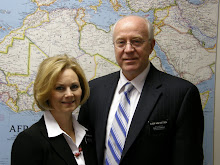
A bit of humor if I may, before we show this land of mountains. My dear wife needed some hair products on Saturday morning and we were running a bit late for our appointment, but, since it was Valentine's Day and she is a special lady, I agreed to drive into the downtown of Maseru where we spotted a Shop-rite market that looked as though it had been there since the 50's. We made our purchase after a rather long que, but now we were running late and I really don't like being late...anyone surprised by that? So, instead of going all the way to the end of the block that was quite congested, I checked my mirrors and pulled a U-turn in the middle of the block. I had no sooner accomplished this coy vehicular maneuver, than a policeman stepped in front of my car and waved me over. Remember...I am an American, with a South African licence plate in Lesotho. He showed me his badge-pointed to his logo of Lesotho Mounted Police Service and said to me,"you have offended the laws of this land, I am officer Semlabaka and you have offended the laws of this land which makes you subject to arrest and fine". He then said 'I will get into your car and you will drive me to the police station" He had no gun, no bike and no car. Not even a horse. I said, No you can't ride in my car-church rules, so he said I will ride with these men (another SA car they had pulled over) and you will follow us to the police station for you have offended the laws of this land. We did so and drove to a very old police station where we stood at the counter while the officer walked around to the back of what looked like a bank teller window and then he asked,"Can I help you?" We tried not to laugh and he then said "ID please". We produced the copies of our passports that we carry and he took out a piece of plain white lined notebook paper and wrote me up. He charged us 30 Mulati ($3) for offending the laws of their land and gave us the only copy of the citation as our receipt. Un-believable. When he said we could go, I asked him if he could come outside so we could take his photo and he practically ran outside ahead of us...he then asked where he should stand and how he should pose... and when we showed him the picture in the camera, he gave us his address so we could send him a copy. A friend for life! God is truly with us.
 Jim with Officer Semlabaka. Do I look like a guy who might have spent the weekend in jail until the judge returned on Monday? Whew! Happy Valentine's Day to me!
 Here is the only record of my "offence to the laws of the land" Wonder where the 30 Maluti went?? A classic keepsake for sure.
 This is a very typical home in the city of Maseru. Each family of 4-7 in a separate unit with no inside water or power.
 As you begin to leave the city, you see more settlements on the hillsides. Everyone but a few, walk everywhere they go. Jobs are scarce but poverty is not.
As we left the city of Maseru, we began climbing into the mountains and saw houses that were part new design (concrete block) and part old native Maloti style home with thatched roof.
 We spent the day in the car driving through the mountains and had packed a few light snacks and fruit since we did not know what we might find for lunch, but fortunately we came upon this lovely little roadside cafe in which to dine.
...just kidding Mom.
We did end up giving all our snacks, sweets and fruit away however, to village children who asked for it as we drove through.
 This is a Lesotho duplex. Two families, one fruit tree, one clothes line. Reenie commented several times that in spite of their poverty, the people were clean and their clothes were always clean as well.
 Up in the mountains you will find the Maloti people who are mostly shepherds. They wear a blanket in all weather and almost always a hat of some sort. This day it was about 18 degrees (about 65F) and still they wore blankets and hats.
 This young man was riding his donkey toward his herd, but when he saw that we wanted his picture, he stopped and posed and asked if we had anything to give him. Before he asked us however, he crossed his left arm over his right forarm (see photo closely) which is a sign of respect for his elders. He got off his steed and we gave him several coins and a pear.
 He was pleased and said "thank you vedy vedy much sa"
 Here is a large settlement of traditional houses that are made of stone and thatch. All are round with one door and two windows. The winters are severe up here in the high country and indoor fires are what keep them warm.
 We went and visited a school in the mountain town of Makoallong. This was a Saturday, but the kids were there, having walked 3k-7k to get there. Here is the primary level school house-no lights-no indoor plumbing-no cafeteria, no gym or swimming pool. Just a room with few supplies.
 Here is a class with 48 students-2 and 3 to a desk-some in uniform, some not, but they are there on Saturday to get as many days in as possible before winter sets in during June-Aug and the snow is too deep to walk to school. The class has ages 6-11 and is reminiscent of what education must have been like in the US in the 1800's. School is free up to age 13, and then each student is charged for lessons and books. As a result, many drop out at that point because of lack of funding. We are working with several young adults, even at the ages of 20-26, to go back and get their basics and we will provide the funding through PEF. It's good to see their faces when they realize they get a second chance.
 Here is the main component. A happy and determined teacher, willing to endure lousy conditions and little in the way of supplies, but who is there for those that are anxious to come and learn.
We both commented as we pulled away from the school how we wished that we had just a portion of the money that has been squandered away by the greed in the U.S. recently, and that we could use it to help these children along lifes road a bit. I have always been a grateful sort, and I lived pretty close to the vest, but this experience is teaching me imeasuably about the terms 'poor and the afflicted. About reaching down to lift up, about orphans at young ages, about grandparents giving the little they have to help with the orphan grandchild. About gathering wood for winter in a land virtually void of trees. About a few families pulling together to see to the secuity and survival of all. Memories of Christmas cards from the 1950's. Much changes-much stays the same, it just depends on who you are and where and when you were born.
 We passed this woman high up in the mountains. She was reluctant to stop to talk to us, but I gave her a 10 Rand note, which is eqivalent to $1 to me, but an entire day's work for her, and she agreed to let us photograph her. She is carrying a large bundle of thick, heavy,dead leaves from a plant that looked like a giant Yucca plant. These will be used to burn in her home during the winter. She had a saw on top of her load and miles and miles to go to the next possible dwelling. The walk was all up hill. She sang softly to herself as she walked...perhaps for herself or perhaps for the little one.
 Much to my surprise, in addition to the load on her head, she was carrying her child on her back. It pains me to see how hard these people have to work just to sustain life and limb, but they do it because they have to. Life expectancy in Lesotho is 47 yrs.
 Here are the large beautiful Lesotho mountains...

...and here is a child whose face we shall not soon forget.

 We passed this woman high up in the mountains. She was reluctant to stop to talk to us, but I gave her a 10 Rand note, which is eqivalent to $1 to me, but an entire day's work for her, and she agreed to let us photograph her. She is carrying a large bundle of thick, heavy,dead leaves from a plant that looked like a giant Yucca plant. These will be used to burn in her home during the winter. She had a saw on top of her load and miles and miles to go to the next possible dwelling. The walk was all up hill. She sang softly to herself as she walked...perhaps for herself or perhaps for the little one.
 Much to my surprise, in addition to the load on her head, she was carrying her child on her back. It pains me to see how hard these people have to work just to sustain life and limb, but they do it because they have to. Life expectancy in Lesotho is 47 yrs.
 Here are the large beautiful Lesotho mountains...
...and here is a child whose face we shall not soon forget.

Blessed are they that mourn; for they shall be comforted.
Blessed are the meek; for they shall inherit the earth.
Matthew 5:4-5
Stay well...


.JPG)

.JPG)
.JPG)
.JPG)
.JPG)
.JPG)
.JPG)


.JPG)